
Oral History
Donna Blaze Johnson
Life from 1970s to Early 2000s
About this interview
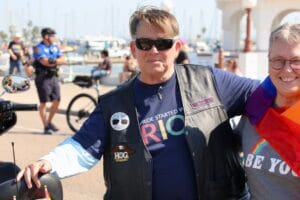
Donna Blaze Johnson traces her journey from coming out in 1977 through decades of LGBTQ community building in Corpus Christi and beyond. She discovered the gay bar scene through a newspaper series, became the first woman bartender at venues like the Zodiac and Jolly Jack, and performed with her band Donna and the Daves while struggling with addiction. The vibrant pre-AIDS era she describes, filled with drag shows, Splash Day beach parties, and seawall cruising, was devastated by the epidemic that claimed an entire generation of friends. After getting sober in 1985 through treatment in Port Arthur, Donna found new community in AA's sober biker culture, eventually leading Corpus Christi's Pride Parade with Dykes and Friends on Bikes and riding with the Chrome Divas. Moving to New York in the late eighties opened her eyes to how oppressed she'd been in Texas. Now she mentors LGBTQ youth, promising them chosen family and assuring them it gets better, while reflecting on her butch identity and the reclaimed language of resilience.
Photographs & memorabilia · 6
Highlights
- 0:00–6:25
Donna Blaze Johnson recounts her coming-out story from the summer of 1977, including her experience at a church camp, confusion about her sexuality, and eventually coming out to her parents in 1979 with her sister's help.
- 6:35–9:39
Donna describes discovering the gay bar scene in Corpus Christi in the mid-to-late 1970s, including the Jolly Jack, the Zodiac, and the White Rabbit, learning about them through a Caller-Times series on LGBT issues.
- 9:39–11:58
Donna recalls becoming the first woman bartender in the LGBT community, working at the Zodiac and Jolly Jack, and describes the vibrant pre-AIDS community with drag shows and the drag queen Michelle Lee.
- 11:46–12:51
Donna describes the murders of beautiful gay men who were part of the community, including a deaf man picked up on the seawall and murdered, foreshadowing the AIDS crisis to come.
- 12:57–14:56
Donna talks about drag shows at the Zodiac and Michelle Lee. Expressing sentiments of community and feeling safer but having cars being vandalized.
- 14:59–17:27
Donna describes getting her first motorcycle when she got sober in 1985, being voluntarily committed to Six West at Memorial Hospital by her ex-girlfriend who was a psych nurse, and then going to treatment in Port Arthur.
- 17:32–24:58
Donna reflects on the devastating AIDS crisis, describing the loss of an entire generation of beautiful men, government indifference, community response including ACT UP activism in New York, and how it compares to COVID.
- 24:58–25:57
Donna describes getting sober in 1985, being voluntarily committed to Six West at Memorial Hospital by her ex-girlfriend who was a psych nurse, and then going to treatment in Port Arthur.
- 25:57–27:21
Donna describes The Hidden Door opening in 1980 as a small men's cruising bar with an upstairs area possibly involving bears and leather, and mentions a nearby lesbian bar on Staples.
- 27:21–28:50
Donna recalls performing in a band called Donna and the Daves at the lesbian bar while drunk and high, describing herself as a train wreck but having a three-octave vocal range.
- 28:50–32:31
Donna names community icons from the era including Michelle Lee, Priscilla, and Marsha Lee Shinus, a published playwright from Corpus Christi who was fired from the Playhouse when they discovered she was gay.
- 32:31–36:24
Donna describes returning to Corpus in 2001 to find The Hidden Door expanded, meeting old friends like Chris (Aaron Davis), and learning about the Coastal Bend AIDS Foundation founded by her friend Tommy Landrum.
- 36:24–40:05
Donna expresses gratitude for the Coastal Bend Wellness Foundation and Pride Center while wishing more people would use it.
- 40:17–43:30
Donna discusses the importance of the Pride Parade for visibility and safety, explains the Dykes on Bikes tradition in San Francisco and New York, and describes leading the Corpus Christi parade as 'Dykes and Friends on Bikes.'
- 43:37–45:53
Donna recalls Splash Day beach parties at Mile Marker 27 in the '70s and '80s that bars organized on Padre Island.
- 46:01–49:56
Donna reflects that if she were young today she might have transitioned given her male identity as a child, but AA taught her self-love, and she now deals with bathroom harassment as a butch woman.
- 49:56–53:17
Donna offers advice to LGBT youth to keep their heads down until they turn 18, assures them it gets better, and promises the community will be their chosen family and help them learn to date and survive.
- 53:17–55:53
Donna explains how she learned to ride motorcycles from sober bikers in AA after treatment, and describes her favorite ride—the Three Twisted Sisters—with the Chrome Divas women's motorcycle group.
- 55:53–59:01
Donna explains the history of 'dyke' as a slur that was reclaimed, traces its etymology to the Celtic queen Boudica, and discusses how butch/femme roles were once structured like heterosexual relationships.
- 59:01–1:02:12
Donna reflects on experiencing little direct discrimination in South Texas as a younger butch woman, but realizing only after moving to New York in the mid-to-late '80s how oppressed she had been, seeing people hold hands freely there.
Explore these topics
Interested in one of these? Tap a topic to find other interviews that touch on it.